
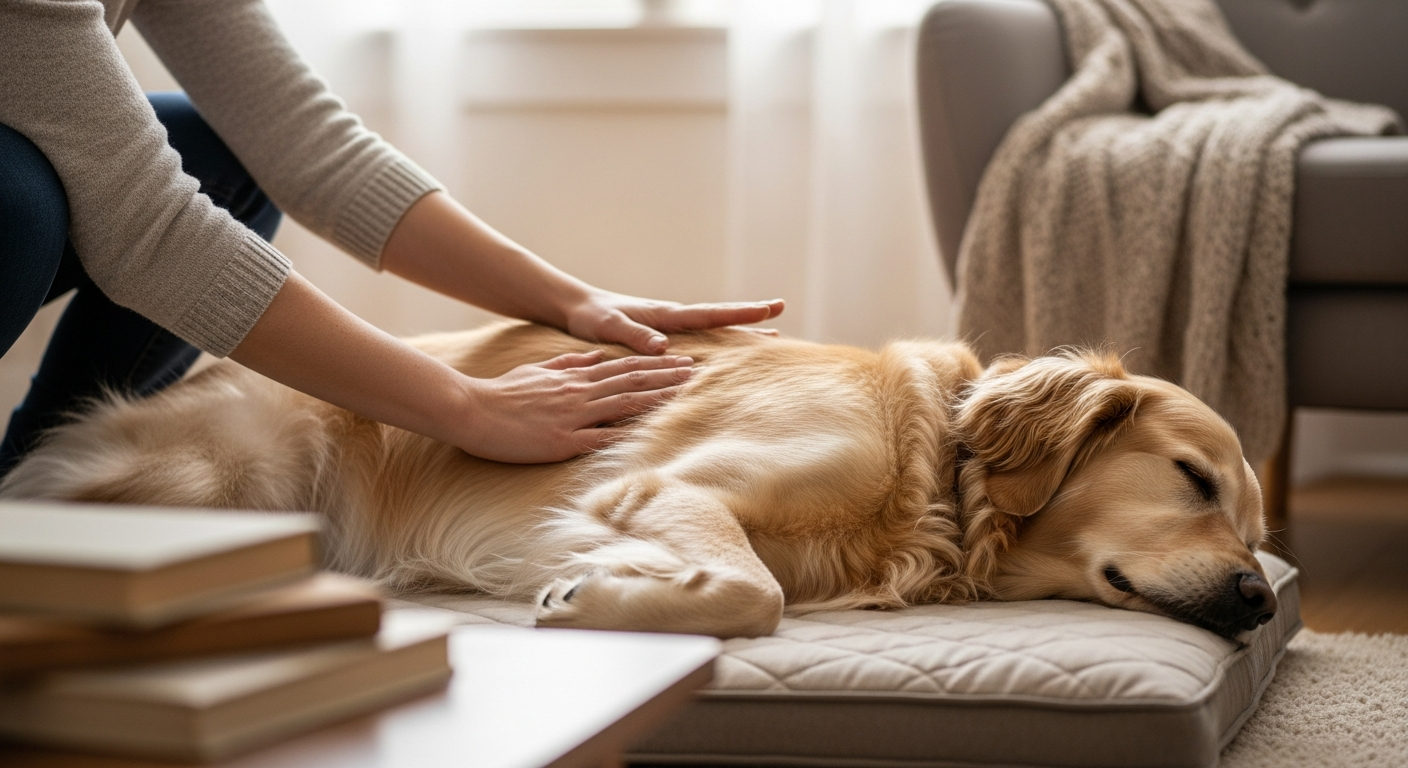
Most dog owners think of a walk as complete when the leash comes off. In fact, the 15 minutes after a walk are one of the most underused windows for supporting a dog's physical and mental recovery. A simple 10-minute post-walk routine combining cool-down, massage, and gentle stretching delivers measurable benefits for muscle recovery, joint comfort, hydration support, and behavioral settling. This article describes the sequence I teach to owners in my certification workshops, adapted for home use without specialized equipment.
Why a Post-Walk Routine Matters
Exercise produces micro-damage in muscle fibers, lactate accumulation, and reduced hydration. These are normal physiological responses that resolve naturally within hours to days, but the rate of resolution is influenced by what happens in the recovery window. In human sports medicine, a structured cool-down has been shown to reduce delayed onset muscle soreness and improve next-day performance. Parallel principles apply to canine exercise physiology, particularly for working dogs, athletic dogs, and senior dogs whose recovery capacity is reduced. A 2019 review in the Journal of Veterinary Behavior noted that post-exercise relaxation protocols also reduce cortisol levels and support behavioral settling, which is particularly valuable for high-drive breeds.
The 10-Minute Routine
Minutes 1-2: Active Cool-Down
The walk should not end abruptly. If the last segment has been vigorous, slow the pace for the last 3 to 5 minutes to bring the dog's breathing and heart rate closer to baseline before stopping. At home, offer fresh water immediately but do not pressure the dog to drink; some dogs drink right away, others wait 5 to 10 minutes. Allow the dog to choose a comfortable resting spot and settle before you begin bodywork.
Minutes 3-5: Effleurage
Once the dog has settled into a relaxed position (usually lying on their side), begin slow, long effleurage strokes from the base of the tail toward the shoulders. Use the flat of your hand, following the direction of hair growth. This stroke supports venous return and lymphatic drainage, which helps clear metabolic byproducts accumulated during exercise. Press gently; this is not the moment for deep pressure. Our guide on Swedish massage techniques for dogs explains effleurage technique in detail for owners new to bodywork.
Cover both sides, the hindquarters, the chest, and the shoulders. Each pass takes 10 to 15 seconds; repeat 4 to 6 passes per region. Watch the dog's breathing as you work; it should slow and deepen, with visible relaxation of the jaw and ears.
Minutes 6-8: Targeted Work
Focus on areas likely to accumulate tension from walking: the shoulders (particularly in dogs who pull on the leash), the rear hip region (particularly in senior and athletic dogs), and the neck (particularly in dogs wearing collars rather than harnesses). Use the pads of your fingers to apply gentle circular pressure over the muscle tissue, not directly over bone or joint. Stay 10 to 15 seconds per point before moving to the next. If you notice a tight band of muscle that does not release, return to it once more after general effleurage, but do not force release; chronic tension patterns may need professional trigger point therapy.
Minutes 9-10: Gentle Range of Motion
For dogs who tolerate it, very gentle passive range of motion supports joint health and mobility. Lift the front leg and slowly flex and extend the shoulder, elbow, and carpus within the dog's comfortable range; do not force. Repeat 3 to 4 times per leg. Do the same with the hip, stifle, and tarsus on the rear legs. If the dog resists, does not relax, or shows pain, stop that motion and consult a veterinarian before continuing. The American Animal Hospital Association's rehabilitation guidelines emphasize that range of motion exercises are safe only within pain-free range.
Finish with a minute of still, resting hand contact on the dog's shoulder or chest. Many dogs fall asleep at this point. That is the desired response and should be respected.
Adjustments for Different Dog Types
Athletic or Working Dogs
Increase the effleurage time to 4 to 5 minutes and extend the total routine to 12 to 15 minutes after intense exercise. Focus additional time on the hindquarters and the epaxial muscles along the spine. Sport dogs benefit particularly from sports massage work on rest days between competitions.
Senior Dogs
Shorten the active cool-down (senior dogs typically walk at lower intensity anyway) and extend the effleurage phase while reducing pressure. Avoid any aggressive range of motion; stick with very gentle, small-amplitude movements. Our senior dog massage protocol covers the specific considerations for aging patients.
Anxious or Reactive Dogs
The post-walk routine is particularly useful for anxious dogs because the repetitive, predictable contact supports parasympathetic activation. Keep the environment quiet and low-stimulation, and extend the opening still-contact phase to 2 to 3 minutes before beginning strokes. Our article on massage for anxious dogs expands on this population.
Puppies
Puppies under 12 months tolerate shorter, gentler routines (5 to 7 minutes total) and benefit more from the bonding and habituation than from the physical recovery aspect. Use very light touch and avoid any manipulation of growing joints.
When to Skip the Routine
Skip or modify the routine if the dog: is still actively panting from recent exertion (wait until breathing has normalized); is eating (wait 30 minutes post-meal); shows signs of injury or severe lameness (address medical issue first); is in active heat cycle with sensitivity; or is showing behavioral signs of not wanting contact (turning away, displacement behaviors). Respecting the dog's signals is essential; a forced routine does more harm than no routine.
Integration with Other Recovery Practices
The post-walk routine pairs well with other evidence-based recovery practices. Ensuring the dog has access to fresh water, an orthopedic bed, and a quiet rest environment after the routine extends the benefit. For dogs with mobility challenges, combining the post-walk routine with a weekly hydrotherapy session or a veterinary rehabilitation program delivers a layered benefit. Our overview of the benefits of canine massage covers the broader context.
The AKC's exercise recovery resources complement this protocol and align with the evidence-based approach to active dog care.
Making It a Habit
The biggest barrier to an effective post-walk routine is not skill; it is consistency. My recommendation is to treat it like a daily ritual rather than an optional add-on. Pair it with an existing habit (the dog's post-walk water, your coffee after returning home) so the routine triggers itself. Within 2 to 3 weeks of daily practice, both you and your dog will likely notice the difference: your dog settles faster, seems to recover from walks with less stiffness, and often seeks out the session by lying down where massage usually happens. That signal, the dog actively inviting the routine, is the best evidence it is working.