
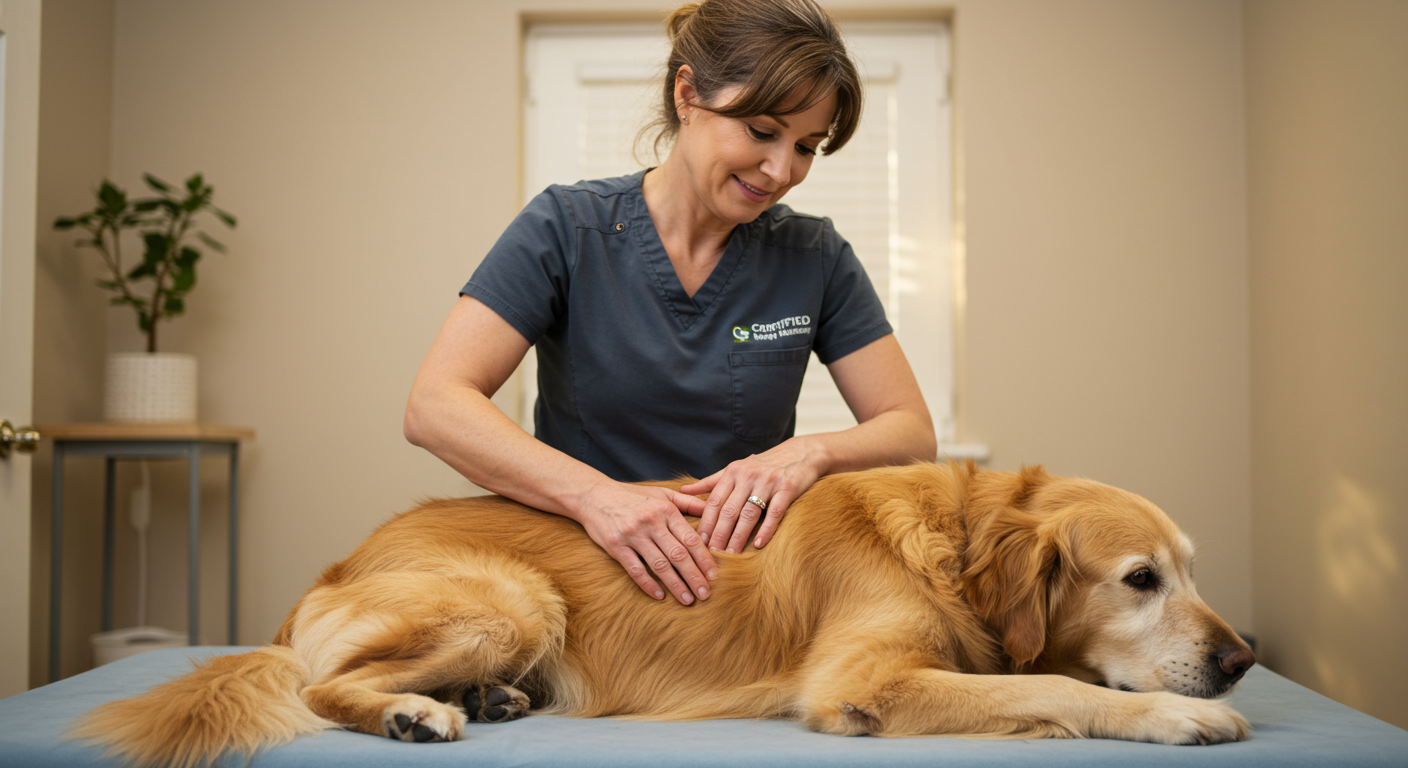
The senior dog is the patient I see most often in my practice, and the one who benefits most visibly from regular massage. Aging dogs face a predictable cluster of issues: osteoarthritis in multiple joints, age-related muscle loss (sarcopenia), stiffness, reduced circulation, sleep disruption, and often mild cognitive changes. Each of these compounds the others. Massage will not reverse the underlying aging process, but when done correctly it meaningfully improves comfort, mobility, sleep quality, and the dog-owner relationship. This article lays out a complete gentle protocol owners can learn to perform at home, with explicit guidance on the warning signs that mean you should stop.
Before You Start: Veterinary Clearance
Massage is generally safe for senior dogs, but it is not appropriate in every situation. Conditions that require veterinary clearance or modification before starting a home massage routine include: unstable cardiac disease, untreated hypertension, recent surgery (within 4 weeks for orthopedic procedures), acute infection, open wounds, known or suspected tumor over the site to be massaged, and severe osteoporosis or advanced bone disease. The American Association of Rehabilitation Veterinarians recommends that owners planning a home massage program for a dog with multiple chronic conditions consult with the primary veterinarian first to identify regions to avoid.
The American Veterinary Medical Association's senior pet care FAQ emphasizes that comfort-focused interventions pair best with an up-to-date pain management plan established with the veterinarian.
Session Environment and Positioning
Senior dogs are most comfortable on a padded surface at a height that does not require them to jump or climb. An orthopedic bed on the floor or a low-profile grooming table padded with a folded quilt works well. The room should be quiet, warm (72 to 76 F is ideal), and dimly lit. Many senior dogs prefer to lie on their side; others prefer sternal recumbency with a rolled towel supporting the chest. Let the dog choose the position. Do not massage a dog who is standing or restless; return to massage only when the dog has settled into a relaxed posture.
The 15-Minute Home Protocol
The following protocol assumes a dog with moderate osteoarthritis but no acute pain and no contraindications. Adjust intensity based on your dog's response; many senior dogs prefer lighter pressure than you would expect.
Minutes 1-2: Opening Contact
Begin with a full-length, relaxed hand placement along the side of the dog, running slowly from neck to tail and down to the hip. No stroke pressure yet. This allows the dog to notice and accept your presence. Repeat 4 to 6 times on each side. Warm your hands by rubbing them together before contact if they are cold; a cold hand placement makes most dogs tense.
Minutes 3-5: Effleurage on the Back and Sides
Begin effleurage, the gliding stroke that moves lymph and blood toward the heart. Stroke from the base of the tail toward the shoulder, using the flat of your hand with light to moderate pressure. Work both sides. Avoid direct pressure over the spine; stroke along the long muscles on either side of the spinal column. Our guide to Swedish massage techniques for dogs covers effleurage technique in detail.
Minutes 6-9: Shoulder and Neck Work
Senior dogs commonly develop tightness in the trapezius and rhomboid muscles from compensatory loading. Use slow, deliberate circular pressure with the pads of your fingers over the shoulder and along the base of the neck. Pressure should be light to moderate; never use force. Watch for the dog relaxing the neck deeper into your hand, a sign that the muscle is releasing.
Minutes 10-12: Hip and Thigh
The hip girdle is a critical area for senior dogs, particularly those with arthritis. Use slow effleurage along the quadriceps, then petrissage (gentle muscle kneading) over the gluteals and hamstrings. Stay lateral (side) and avoid deep pressure directly over the hip joint itself. Many osteoarthritic dogs have trigger points in the gluteus medius; these respond well to sustained light pressure rather than kneading. Our page on trigger point therapy in dogs covers this in greater depth.
Minutes 13-15: Closing Effleurage and Still Touch
Return to full-body effleurage to integrate the session. Finish with a minute of still, resting hand placement on the dog's chest or shoulder. This is the moment many dogs fall asleep during sessions, which is a good sign and should be allowed.
What to Avoid
- Deep pressure. Senior dogs bruise more easily and have thinner skin and reduced pain tolerance.
- Direct pressure on the spine, sternum, or any bony prominence.
- Joint manipulation or stretching unless you have been specifically trained. Passive range of motion requires professional instruction.
- Massaging over known masses or lumps.
- Prolonged sessions. Keep initial sessions to 10 to 15 minutes. Senior dogs do not tolerate long sessions as well as younger dogs.
- Massage immediately after eating. Wait at least 60 minutes post-meal to reduce GI risk.
Reading Your Dog's Signals
A dog who is benefiting from massage will show specific signs: relaxed ears and jaw, slow breathing, closed or half-closed eyes, occasional deep sighs, and sometimes falling asleep. A dog who is not benefiting shows different signs: pulled-back lips, panting without heat stress, moving away from contact, stiffening when touched in a specific area, or whale-eye (showing white of the eye). Stop immediately if any of these appear, and note the area where the response occurred. Discuss with your veterinarian; it may indicate pain from an undiagnosed issue.
Frequency and Progression
Start with one 10-minute session every 2 to 3 days. After 2 to 3 weeks, if the dog is tolerating and seeking out sessions, you can extend to 15 minutes and up to every other day. Avoid daily sessions; muscle tissue needs recovery time between bodywork sessions, and over-frequent massage loses its effect. A reasonable long-term rhythm for most senior dogs is 3 to 4 sessions per week, matched to your dog's preference.
Many owners find that pairing a short massage with a post-walk routine helps the dog settle and recover more quickly. Our guide on post-walk massage routine describes the specific sequence and timing.
Combining Massage with Other Therapies
Massage works best as part of a multimodal approach. For senior dogs, the most effective combinations I see in clinical practice are: massage plus appropriate pain medication (NSAIDs, monoclonal antibody therapy, or gabapentin as prescribed); massage plus hydrotherapy; massage plus veterinary physical rehabilitation; and massage plus environmental modifications (ramps, non-slip surfaces, orthopedic bedding). The goal of massage in this context is not to replace any of these, but to support and extend their effects.
The AKC's senior dog arthritis management resources provide a useful framework for integrating multiple treatment modalities. Our articles on the benefits of canine massage and massage for anxious dogs cover adjacent topics that may apply to individual senior dogs.
When to Seek Professional Help
Home massage supplements, but does not replace, professional canine massage therapy for complex cases. Consider a professional practitioner if your dog has multiple orthopedic conditions requiring targeted work, has not responded to home massage, is recovering from surgery, or has behavioral issues that make home massage difficult. Certified canine massage therapists (CCMT, CCMPT) maintain professional directories, and any professional you choose should have demonstrable training and liability insurance.
The difference a regular home massage routine makes in a senior dog's daily life is often obvious within 2 to 3 weeks: faster recovery from walks, better sleep, reduced reluctance to be petted, and a more visible sense of ease. For many owners, the sessions also become a meaningful daily ritual that strengthens the bond with a companion who has been part of the family for a decade or more.